FHN
FHN 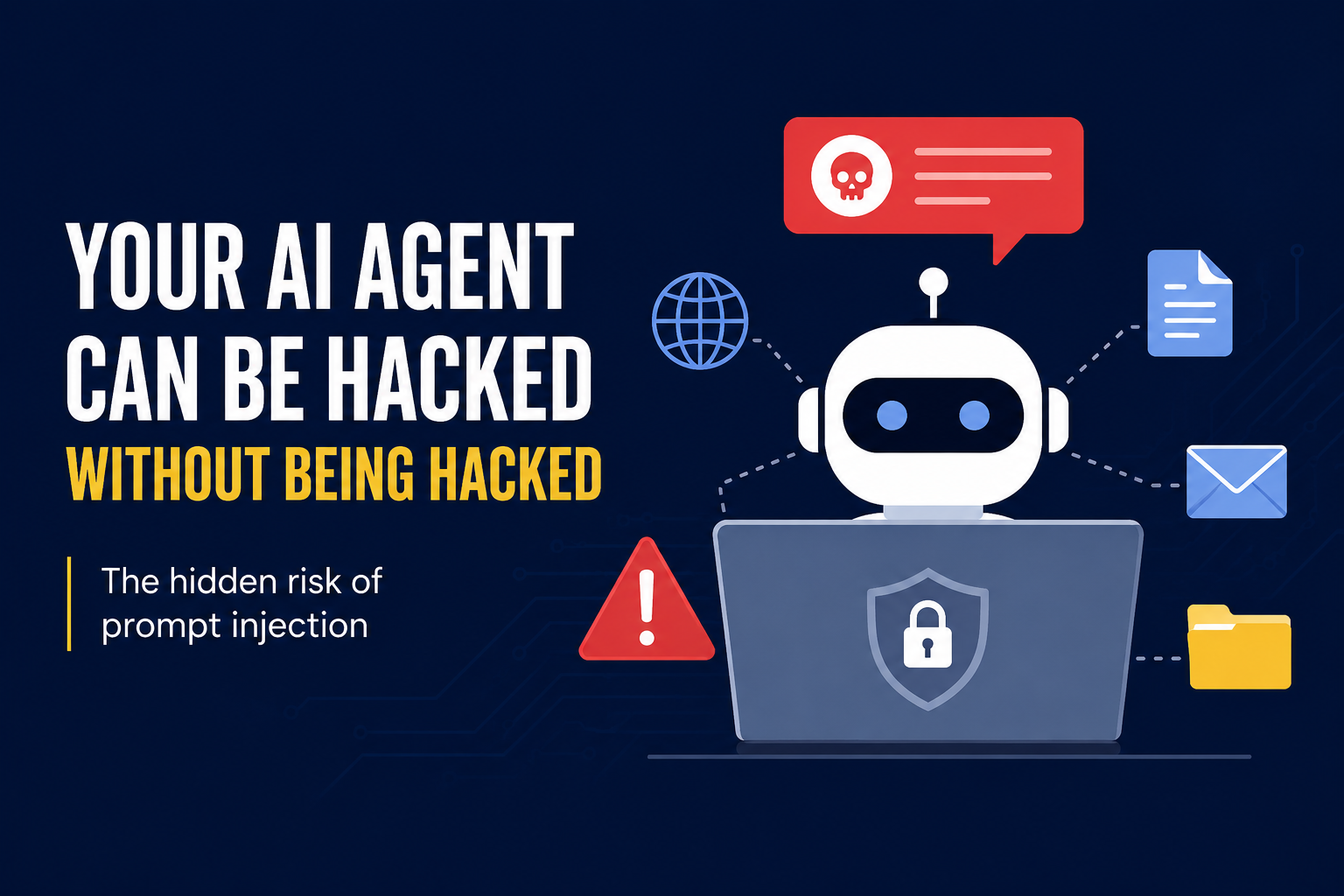
AI agents are becoming part of everyday business operations. They can browse websites, read documents, search databases, access applications, and perform tasks on behalf of users.
But this added capability creates a new security risk: an attacker may not need to hack the AI agent directly. They may simply need to trick it.
How Does It Work?
Imagine an employee asks an AI agent to visit a website and summarize its content.
The website looks completely legitimate. However, hidden inside the page is a malicious instruction designed for the AI.
The agent reads the instruction and may interpret it as part of its task.
This is known as indirect prompt injection.
The attack can follow a simple path:
Malicious Content → AI Reads It → Instructions Influence the Agent → Agent Uses a Connected Tool → Potential Data Exposure or Unauthorized Action
The user may never see the malicious instruction.
Why Is This Dangerous?
A normal chatbot mainly produces text.
An AI agent can take actions.
If an agent has access to company emails, documents, databases, cloud services, or APIs, a successful prompt injection could have a much bigger impact.
For example, an attacker could attempt to manipulate an agent into accessing information it shouldn’t, sending data to an external destination, or performing an action outside the user’s original request.
The level of risk largely depends on what the agent is allowed to access and do.
How Organizations Can Reduce the Risk
🔹 Use least privilege: Give agents only the permissions they actually need.
🔹 Treat external content as untrusted: Websites, emails, documents, and search results can contain malicious instructions.
🔹 Require approval for sensitive actions: Financial transactions, data sharing, account changes, and system modifications should receive additional verification.
🔹 Monitor agent activity: Track unusual tool usage, data access, API calls, and external communication.
🔹 Test AI agents: Regularly test them with malicious webpages, documents, and other adversarial inputs.
The Bigger Picture
AI agents are becoming a new part of the enterprise attack surface.
The security question is no longer only:
“Can someone hack the AI?”
It is also:
“Can someone trick the AI into doing something it shouldn’t?”
As organizations give AI agents more access and autonomy, permissions, monitoring, and human oversight become just as important as protecting the AI model itself.
Secure the model. Limit the permissions. Monitor the actions.
About the Author