FHN
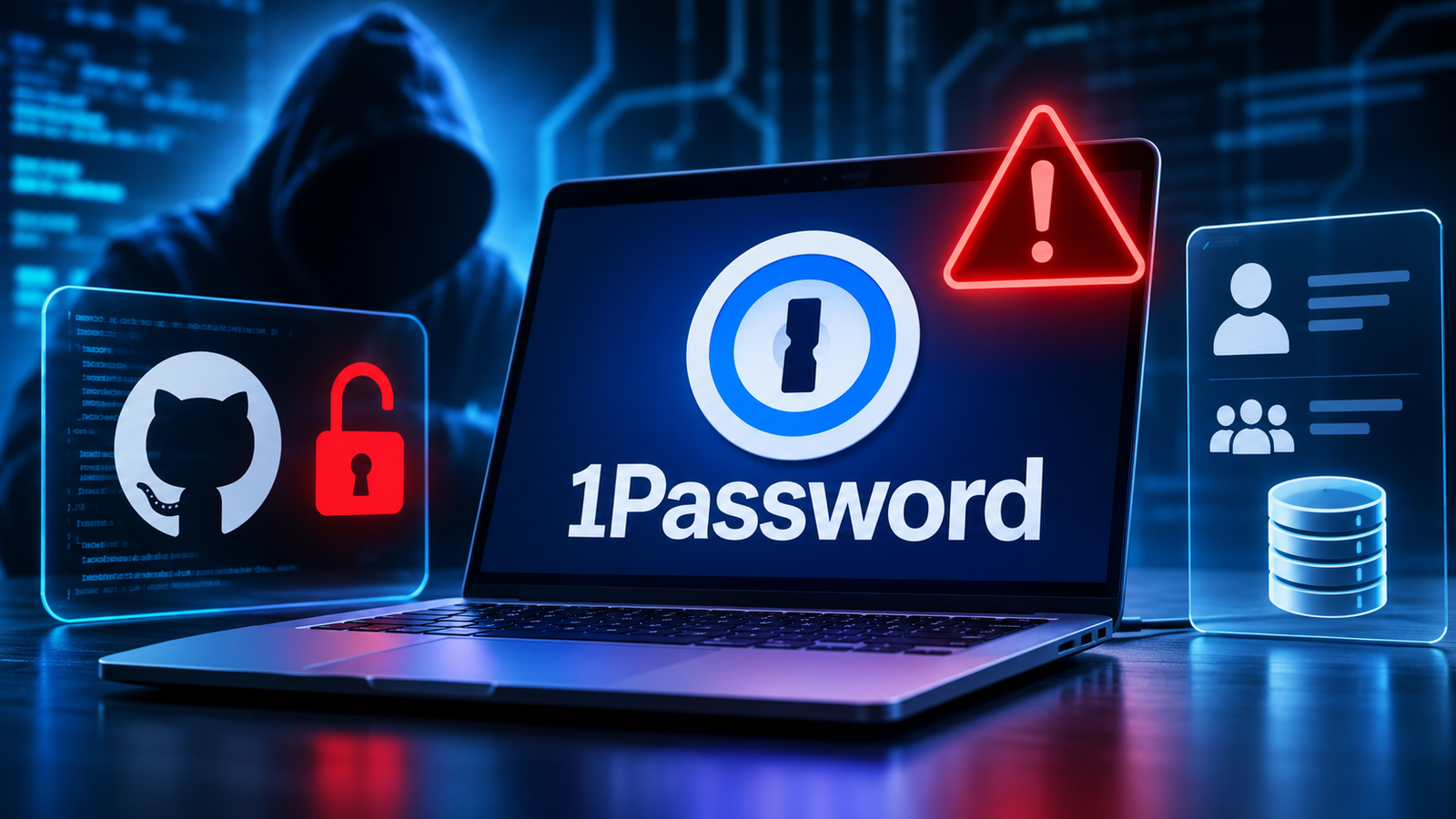
Password management company 1Password has disclosed a security breach after an attacker compromised an employee’s corporate GitHub account and used it to access internal systems and steal customer account information.
The incident, disclosed on November 25, 2026, involved malicious code being pushed to 1Password’s backend services. The code enabled the attacker to download administrative records belonging to a subset of customers.
The exposed information included customer names, email addresses, account identifiers and other internal metadata. However, 1Password confirmed that customer vaults, stored passwords and the encryption keys protecting them were not accessed.
The company also reported that its applications and services continued operating normally following the incident.
How Attackers Compromised 1Password
1Password began investigating the incident on November 19, 2026, after identifying indications that an attacker had gained access to an employee’s corporate GitHub account.
Using the compromised account, the attacker accessed private source code repositories and pushed malicious code to the company’s backend services.
The malicious code enabled the unauthorized download of administrative customer records.
The attacker also copied source code from private repositories and gained access to 1Password’s continuous integration and continuous delivery (CI/CD) environment, which supports the company’s software development and deployment processes.
The CI/CD environment contained infrastructure-related credentials. 1Password subsequently rotated or revoked credentials that may have been exposed.
The company has not disclosed how the employee’s GitHub account was initially compromised or the total number of affected customers.
What Customer Information Was Stolen?
According to 1Password’s incident disclosure, the attacker copied account records belonging to a subset of customers.
The exposed information included:
- Customer names and sign-in email addresses
- Account and user identifiers
- Account creation and last sign-in timestamps
- Public cryptographic keys
- Secure Remote Password (SRP) protocol parameters
- Tokens contained in certain invitation, provisioning and account recovery email links
- Other non-secret internal account metadata
The attacker also copied source code from private repositories.
Although some of the exposed information was related to account provisioning and recovery, 1Password stated that the affected tokens could not independently provide access to customer accounts.
Completing the relevant invitation or recovery process also required single sign-on (SSO) authentication or a separate verification code sent to the registered email address.
The company said it had specifically notified the small number of users whose invitation or recovery tokens were involved.
Were 1Password Vaults and Saved Passwords Compromised?
1Password confirmed that customer vault contents were not accessed during the incident.
The following sensitive information remained unaffected, according to the company:
- Passwords and other items stored in customer vaults
- Encryption keys protecting customer vaults
- Account recovery keys
- 1Password applications and browser extensions
1Password explained that its architecture is designed so that the company itself does not have access to customers’ account passwords or Secret Keys.
Consequently, the attacker did not obtain the vault contents or the keys required to decrypt them through this incident.
The company also reported no internal evidence of customer account takeovers using the exposed provisioning tokens.
1Password Strengthens Security After the Breach
Following the investigation, 1Password implemented several containment and remediation measures.
These included:
- Disabling the compromised employee GitHub account.
- Revoking the stolen access token and removing unauthorized access.
- Restoring clean versions of affected backend services.
- Rotating or revoking potentially exposed internal credentials.
- Strengthening GitHub, CI/CD and endpoint security controls.
- Introducing additional detections for similar activity.
- Engaging independent cybersecurity experts to validate containment and remediation.
As an additional precaution, the company changed verification codes used in certain invitation and recovery emails from six numeric digits to ten alphanumeric characters.
1Password also stated that its services and availability were not affected by the incident.
Phishing Risks for 1Password Customers
Although stored passwords and vault contents were not compromised, the exposed customer information creates opportunities for targeted phishing attacks.
Attackers could use legitimate customer names and email addresses to create convincing messages impersonating 1Password.
Potential phishing scenarios include:
- Fake account security alerts requesting immediate action.
- Fraudulent password reset or account recovery messages.
- Fake provisioning and account invitation emails.
- Messages asking users to disclose their Secret Key or verification codes.
Because attackers may possess real account-related information, users should be particularly cautious about unexpected communications claiming to be from 1Password.
The company advises customers to access their accounts through the official application or by manually entering its website address. It also states that it will never ask users to disclose their account password or Secret Key.
Security Recommendations for Organizations
Organizations using password management platforms should consider the incident a reminder that employee identities and software development environments are critical parts of the security perimeter.
Recommended measures include:
- Conduct regular security reviews of developer endpoints and third-party integrations.
- Enforce phishing-resistant multi-factor authentication for GitHub and other developer accounts.
- Apply least-privilege access controls to source code repositories.
- Protect CI/CD pipelines with strict access policies and secrets management.
- Monitor unusual repository access, token usage and code changes.
- Require approval and security checks before deploying code to production.
- Rotate credentials immediately when unauthorized access is suspected.
- Monitor account recovery and provisioning workflows for suspicious activity.
About the Author