FHN
FHN 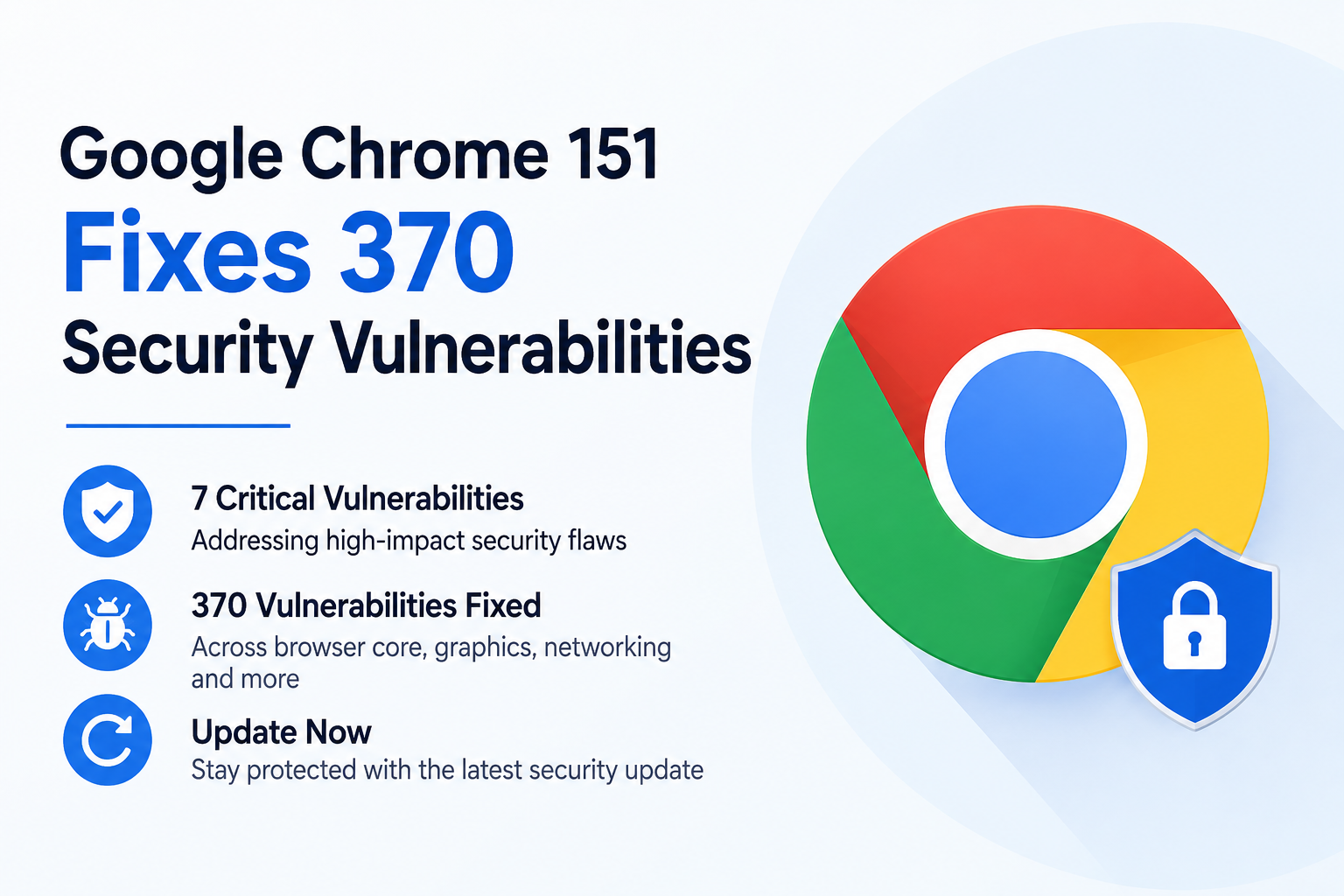
Google has released Chrome 151 for Windows, macOS, and Linux, bringing an important security update that fixes 370 vulnerabilities across the browser. The update is being rolled out gradually, so it may take a few days before it becomes available to all users.
To help reduce the risk of attacks before users install the update, Google is temporarily limiting technical details about many of the vulnerabilities until the rollout is complete.
370 Security Flaws Addressed
This release includes fixes for vulnerabilities affecting several core Chrome components, including graphics, networking, browser rendering, and platform-specific features.
Many of these issues were discovered by Google’s internal security teams using automated testing tools designed to detect memory errors and other software weaknesses before they could be exploited.
Seven Critical Vulnerabilities Fixed
Chrome 151 resolves seven critical vulnerabilities, tracked as CVE-2026-17650 through CVE-2026-17656.
Several of these are use-after-free memory vulnerabilities found in components such as Compositing, Views, Skia, and Ozone. If successfully exploited, these flaws could allow attackers to execute malicious code through specially crafted web content.
The update also fixes:
- Insufficient input validation in the Dawn and ANGLE graphics libraries.
- A race condition in Chrome’s Updater that could lead to unexpected behavior during software updates.
These vulnerabilities could potentially be used to bypass security protections, escalate privileges, or compromise browser stability.
Additional High-Severity Fixes
Beyond the critical issues, Chrome 151 addresses numerous high-severity vulnerabilities affecting components such as:
- V8 JavaScript Engine
- Navigation
- QUIC
- Audio and Media
- WebGL
- Downloads
Many of these flaws involve memory corruption issues, including out-of-bounds reads and writes, integer overflows, and type confusion vulnerabilities, all of which could increase the risk of remote code execution.
Medium and Low-Severity Improvements
The update also includes fixes for medium-severity vulnerabilities affecting features such as Autofill, DevTools, Extensions, Password Manager, WebXR, WebView, and ANGLE.
In addition, Google resolved several lower-severity issues impacting Enterprise features, Bluetooth, NFC, Google Lens, Settings, Picture-in-Picture, and AI-related functionality. While these vulnerabilities are less severe individually, addressing them helps strengthen Chrome’s overall security.
Update Chrome as Soon as Possible
Google credited both its internal security teams and external researchers for identifying many of the vulnerabilities before they could be exploited.
With 370 security fixes, including seven critical vulnerabilities, this release highlights the importance of keeping web browsers up to date. Users and organizations should install Chrome 151 as soon as it becomes available to reduce the risk of attacks targeting known security flaws.
About the Author