China-Linked Hackers Exploit VMware vCenter Zero-Day to Gain Admin Access and Steal Data
 FHN
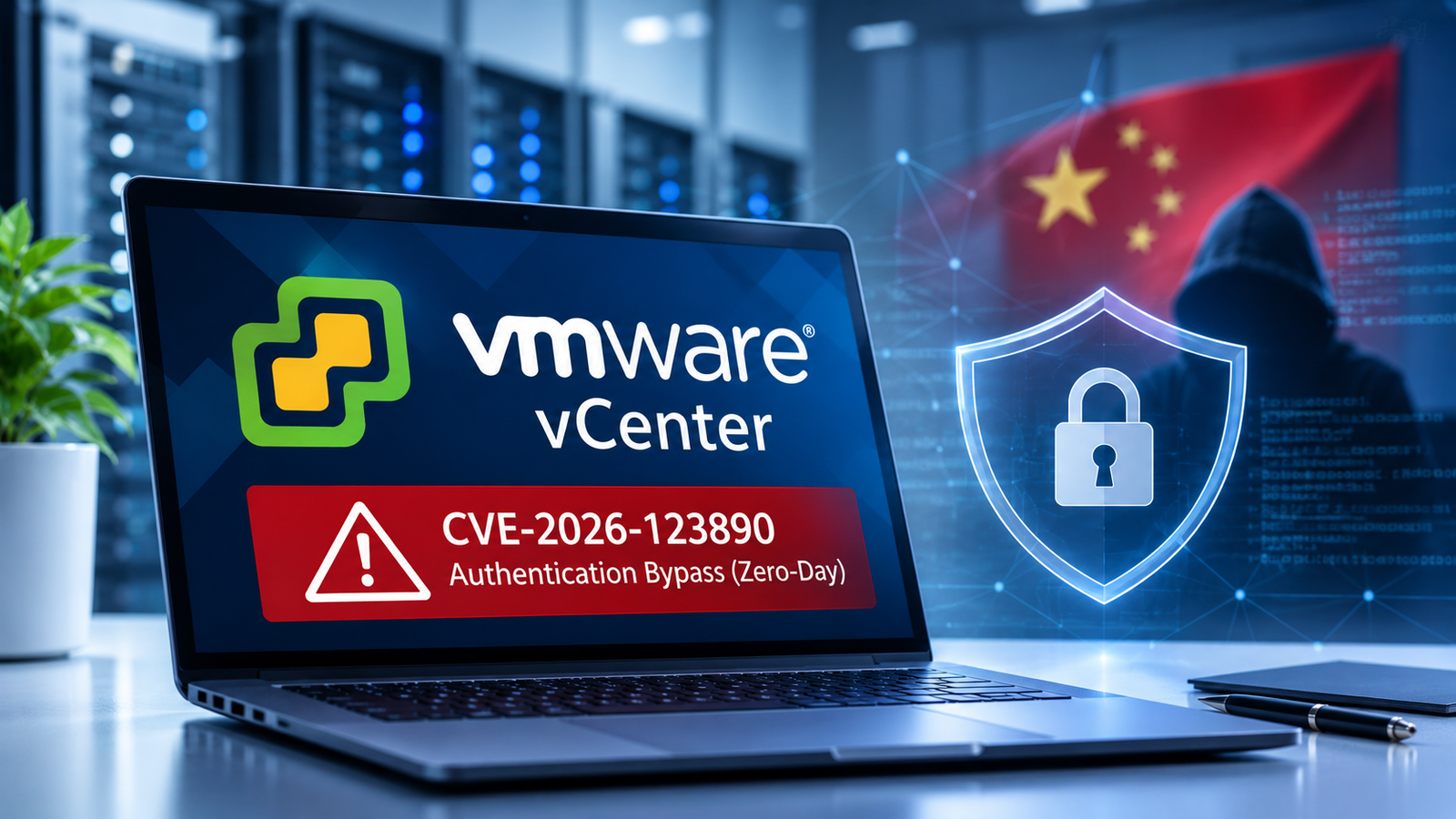
A suspected China-linked cyber espionage group has exploited a critical zero-day vulnerability in VMware vCenter Server to bypass authentication, obtain administrator privileges and steal sensitive data from compromised environments.
The threat actor, identified as Armory Castle, previously tracked as UNC5221, exploited the vulnerability in early September 2026, according to Google Threat Intelligence Group (GTIG) and Mandiant. The activity involved specialized malware, lateral movement across internal systems and targeted access to virtualized infrastructure.
The vulnerability, tracked as CVE-2026-123890, carries a critical CVSS score of 9.8.
VMware vCenter Authentication Bypass Vulnerability
CVE-2026-123890 is an authentication-bypass vulnerability in VMware Directory Service. It involves the disclosure of an unauthenticated Secure Remote Password (SRP-6a) session key over Distributed Computing Environment/Remote Procedure Calls (DCE/RPC).
An attacker with network access to a vulnerable vCenter Server could exploit the flaw to establish an authenticated session as administrator@vsphere.local, effectively gaining administrator-level access without valid credentials.
Following successful exploitation, attackers can execute arbitrary commands and access sensitive files, including the vCenter Directory Service database (data.mdb).
Google and Mandiant reported that Armory Castle weaponized the vulnerability using a custom Go-based utility named BONESAW. The tool was designed to extract the database, hijack the Security Token Service (STS) and create a Single Sign-On (SSO) administrator account.
Armory Castle’s Attack Chain and Malware Arsenal
The vCenter exploitation formed part of a broader intrusion campaign that also involved a zero-day vulnerability in BeyondTrust Remote Support, tracked as CVE-2026-102764.
After compromising the Remote Support appliance, the attackers moved laterally to an internal Linux system, escalated privileges to root and deployed additional tools to expand their access.
The investigation identified several malware families and utilities used during the operation:
- BONESAW: A Go-based exploitation utility used to target vCenter, extract its database and establish an SSO administrator account.
- SAWSNAKE: A Go-based tool capable of generating vCenter SAML authentication cookies, enabling token forgery and account impersonation.
- SLIMSAVAGE and CAGEMATCH: JSP web shells used to execute commands, stage payloads and maintain access to compromised Linux appliances.
- BEARBONES: A C-based backdoor derived from the Dropbear SSH server, capable of bypassing system password authentication and capturing plaintext credentials.
- LAZYBONES: A lightweight Go backdoor that uses Slack for command-and-control communications, including command execution and file transfers.
The attackers also enabled SSH access on the vCenter appliance and created a local administrator account to maintain control.
Attackers Target VMware Virtual Infrastructure
After gaining access to vCenter, Armory Castle expanded its operations into the underlying VMware environment.
The group scanned internal networks for VMware-related services and ports, including 9080, 5480 and 2012. The latter is associated with the vCenter Single Sign-On RPC control interface and played a role in the exploitation process.
The attackers subsequently enumerated the ESXi file system, mounted Virtual Machine File System (VMFS) volumes and added an SSH public key to the root account’s authorized keys.
This activity provided further access to virtualized infrastructure and enabled the attackers to conduct reconnaissance and collect data. The stolen information was archived and transferred through HTTP requests to the compromised Remote Support appliance for subsequent exfiltration.
Google also observed LAZYBONES being deployed on another Linux appliance, where it periodically checked a designated Slack channel for commands.
Broadcom Releases Security Updates
Broadcom disclosed CVE-2026-123890 on November 19, 2026, as part of security advisory VMSA-2026-0009. The advisory assigns the vulnerability a CVSS score of 9.8 and confirms that network access to vCenter is required for exploitation.
Security updates are available for affected VMware products. Key fixed versions include:
- VMware vCenter 8.0: Upgrade to 8.0 U3m.
- VMware Cloud Foundation and vSphere Foundation 9.1.x: Upgrade to 9.1.1.0200.
- VMware Cloud Foundation and vSphere Foundation 9.0.x: Upgrade to 9.0.2.0200.
- VMware Cloud Foundation 5.x: Upgrade to 5.2.5.
- VMware vCenter 7.0: Contact Broadcom Support if operating under an extended support contract.
Broadcom has not provided a workaround for this vulnerability. Organizations should consult the official advisory and apply the appropriate security updates based on their deployed product versions.
About the Author