FHN
FHN 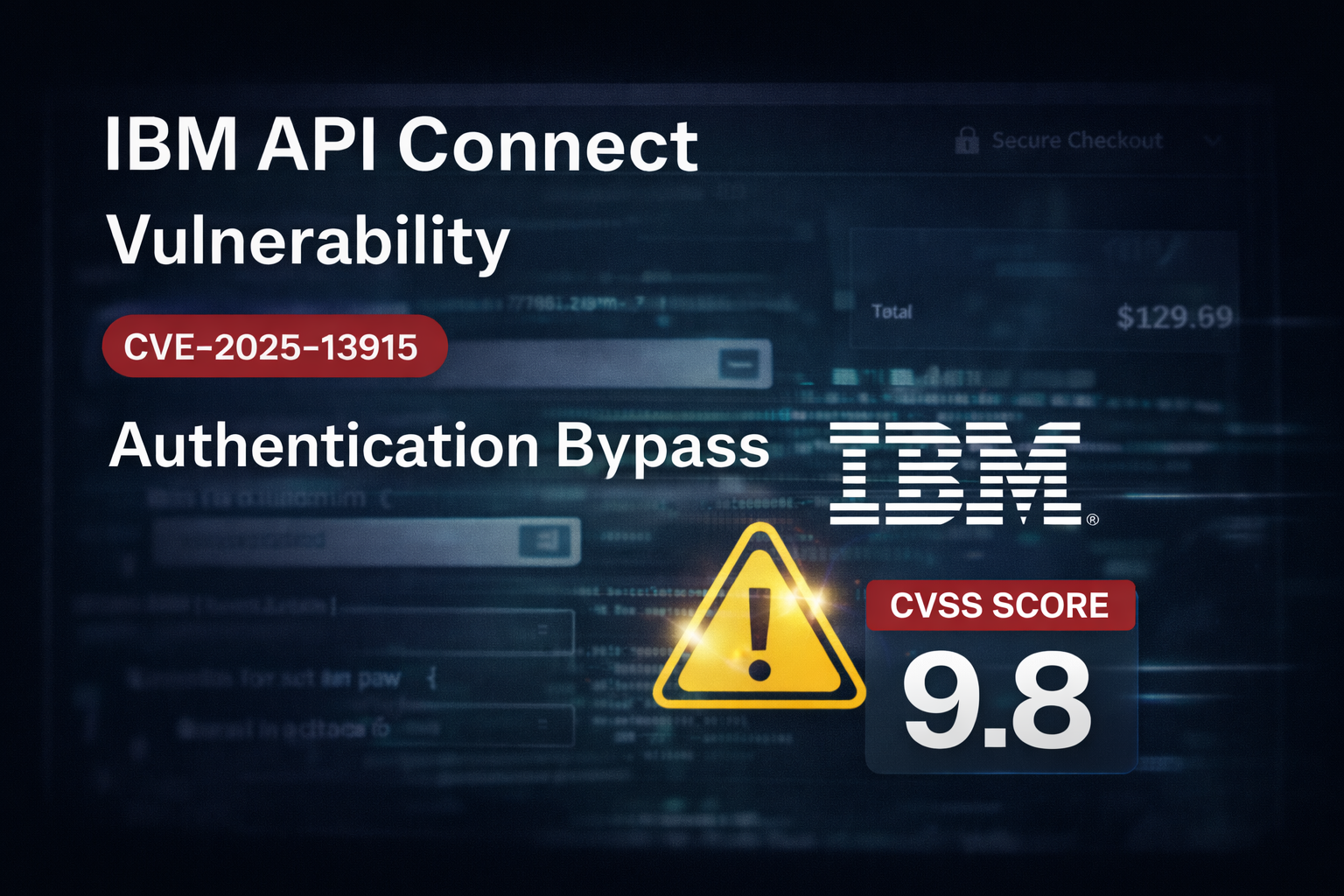
IBM has disclosed a critical security flaw in its API Connect platform that allows attackers to bypass authentication entirely. The vulnerability is tracked as CVE-2025-13915 and has been assigned a CVSS score of 9.8, placing it in the critical severity category.
The issue is caused by a weakness in how API Connect handles primary authentication. An attacker does not need valid credentials, user interaction, or elevated privileges to exploit it. Network access to a vulnerable instance is enough to gain unauthorized access.
Key Details
- CVE ID: CVE-2025-13915
- Severity: Critical
- CVSS Score: 9.8
- Weakness Type: Authentication bypass (CWE-305)
- Attack Complexity: Low
- Privileges Required: None
Affected Versions
The vulnerability impacts the following IBM API Connect versions:
- 10.0.8.0
- 10.0.8.1
- 10.0.8.2
- 10.0.8.3
- 10.0.8.4
- 10.0.8.5
- 10.0.11.0
IBM API Connect is commonly used to control authentication, authorization, and security policies for enterprise APIs. A successful authentication bypass at this layer can expose:
- Backend API services
- Sensitive business data
- Internal application logic
- Downstream systems connected to APIs
Because the flaw sits at the gateway level, exploitation could have a broad impact across environments.
Mitigation and Recommendations
IBM strongly advises customers to apply security updates immediately.
- Users on 10.0.8.x should install the available interim fixes (iFixes).
- Users on 10.0.11.0 should apply the released security patch.
If patching cannot be done right away, IBM recommends disabling self-service sign-up on the Developer Portal to reduce exposure. This is a temporary measure and does not fully remove the risk.
What Organizations Should Do Now
- Identify all IBM API Connect instances in use
- Apply patches or interim fixes as a priority
- Review API access and authentication logs for unusual activity
- Limit external exposure until updates are completed
Given the high severity score and ease of exploitation, this vulnerability should be addressed immediately, not deferred.
Follow Us on: Linkedin, Instagram, Facebook to get the latest security news!
About the Author