FHN
FHN 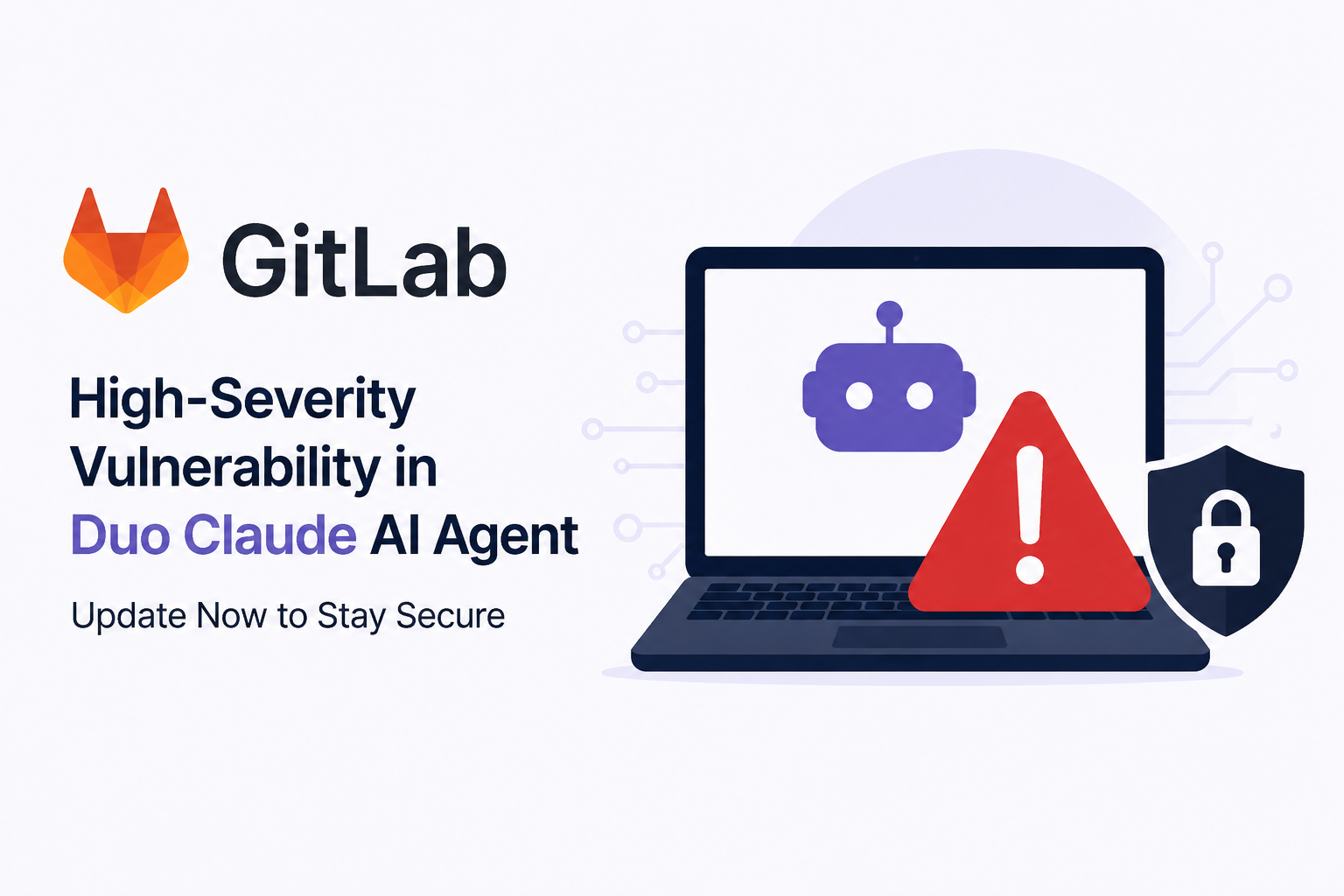
GitLab has released security updates for a high-severity vulnerability in its Duo Claude AI agent that could allow authenticated developers to run unauthorized commands inside CI pipeline environments.
Tracked as CVE-2026-18252, the flaw has a CVSS score of 7.3 and affects GitLab Enterprise Edition. GitLab fixed the issue in versions 19.3.1, 19.2.5, and 19.1.7.
GitLab.com has already been updated, but organizations running self-managed installations should upgrade as soon as possible.
How the Vulnerability Works
The problem is linked to the way the Duo Claude AI agent processes configuration supplied from a user-controlled source.
Under certain conditions, an authenticated user with Developer-level permissions could manipulate this behavior and cause the AI agent to execute arbitrary commands within a CI environment.
This is particularly concerning because CI pipelines often have access to sensitive development resources, including:
- Source code and build files
- Deployment credentials and cloud tokens
- Package registry credentials
- Secrets used by automated jobs
An attacker who gains command execution could potentially access exposed secrets, modify build artifacts, or interfere with software development and deployment processes.
GitLab Releases Security Fix
GitLab classified the vulnerability as an untrusted control sphere issue. Exploitation requires network access, low-level privileges, and user interaction.
There is currently no public exploit or evidence that the vulnerability is being actively exploited.
The same GitLab patch releases also address several other security issues, including denial-of-service vulnerabilities, access-control problems, and weaknesses involving pipeline and compliance policies.
Self-managed administrators should upgrade to the appropriate patched release:
- GitLab 19.3.1
- GitLab 19.2.5
- GitLab 19.1.7
The updates may require database migrations, so administrators should plan the upgrade according to their deployment architecture.
The vulnerability also highlights a broader security concern: AI agents integrated into development platforms should be treated as powerful automation systems with access to code and secrets.
Organizations should restrict access to AI-agent configurations, limit CI secrets, isolate pipeline jobs, and monitor automated workflows for unexpected command execution.
About the Author