Hidden Ad Tracking Operations Found Across 152 Chrome Browser Extensions
 FHN
FHN 
Security researchers have uncovered a large-scale browser extension campaign involving 152 Chrome extensions that secretly conducted ad tracking and generated fraudulent Google search traffic. Many of the extensions were presented as harmless customization tools, such as live wallpapers and browser enhancement utilities, attracting users through seemingly legitimate functionality.
The investigation revealed a coordinated infrastructure designed to manipulate advertising ecosystems while remaining largely hidden from users. Although the extensions appeared benign on the surface, researchers found embedded mechanisms capable of tracking browsing behavior, generating artificial search activity, and redirecting traffic for monetization purposes.
Technical Analysis of the Campaign
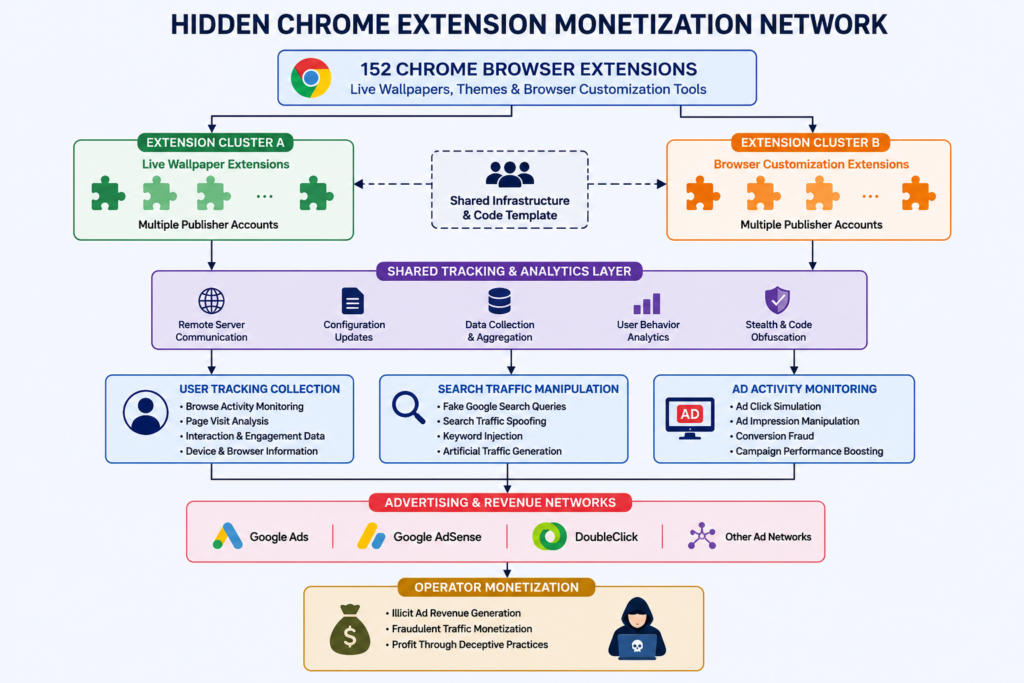
Researchers discovered that the operation was spread across multiple publisher accounts and domains, with over 140 live wallpaper extensions sharing a nearly identical codebase and infrastructure. Despite using separate hosting environments and advertising accounts, the extensions followed the same operational model, indicating a centralized campaign.
The extensions leveraged hidden scripts and remote communication channels to receive instructions and perform actions that were not disclosed in their public descriptions. This allowed operators to modify behavior dynamically while maintaining the appearance of legitimate browser tools.
Campaign Infrastructure
The diagram below illustrates how multiple Chrome Web Store publisher accounts and extension clusters were connected to a shared monetization infrastructure.
How the Extensions Operated
Once installed, the extensions requested browser permissions that appeared reasonable for their advertised functionality. Behind the scenes, however, additional code executed in the background to monitor user activity and interact with external servers.
The collected information was then used to generate advertising-related events and search requests that appeared legitimate. Because the activity originated from real user browsers, it became more difficult for traditional fraud detection systems to distinguish between genuine and manipulated traffic.
Key Activities Observed :
- Hidden user tracking
- Search traffic manipulation
- Browser activity monitoring
- Communication with remote infrastructure
Hidden Tracking and Traffic Manipulation Techniques
The campaign employed several techniques commonly associated with browser-based threats and advertising fraud operations.
Concealed Ad Tracking
The extensions monitored browsing behavior and collected information related to user interactions, allowing operators to analyze traffic patterns and advertising engagement.
Fake Search Traffic Generation
Researchers observed mechanisms designed to create artificial search requests that appeared to originate from legitimate users. This allowed operators to inflate search metrics and potentially increase advertising revenue.
Obfuscated Code
Parts of the extension code were intentionally concealed, making analysis more difficult and reducing the likelihood of detection during routine reviews.
Potential Risks to Users
While the campaign primarily focused on advertising fraud, the broader security implications are significant.
Privacy Exposure
User browsing behavior may be monitored without clear consent or awareness.
Browser Manipulation
Extensions can alter browser activity, search behavior, and website interactions behind the scenes.
Why Browser Extensions Remain a Security Challenge
Browser extensions operate with a level of trust that many users underestimate. Once installed, they can access web pages, monitor browser activity, modify content, and communicate with external servers.
Threat actors increasingly abuse this trust because browser extensions provide persistent access to user activity while often avoiding traditional endpoint security monitoring. As browser ecosystems continue to grow, malicious actors are likely to use similar techniques to conduct tracking, fraud, and data collection operations.
Security Recommendations
Organizations and individual users should take proactive measures to reduce the risks associated with browser extension abuse.
- Review Installed Extensions
- Audit Extension Permissions
- Monitor Browser Activity
- Implement Security Controls
- Conduct Regular Reviews
The discovery of 152 Chrome browser extensions involved in hidden ad tracking and fake search traffic generation demonstrates how browser extensions can be abused for large-scale advertising fraud and user monitoring. While these extensions may appear legitimate, hidden functionality can transform them into powerful tools for tracking, traffic manipulation, and monetization. Organizations should treat browser extensions as part of their attack surface and continuously monitor them as part of a broader security strategy.
About the Author