FHN
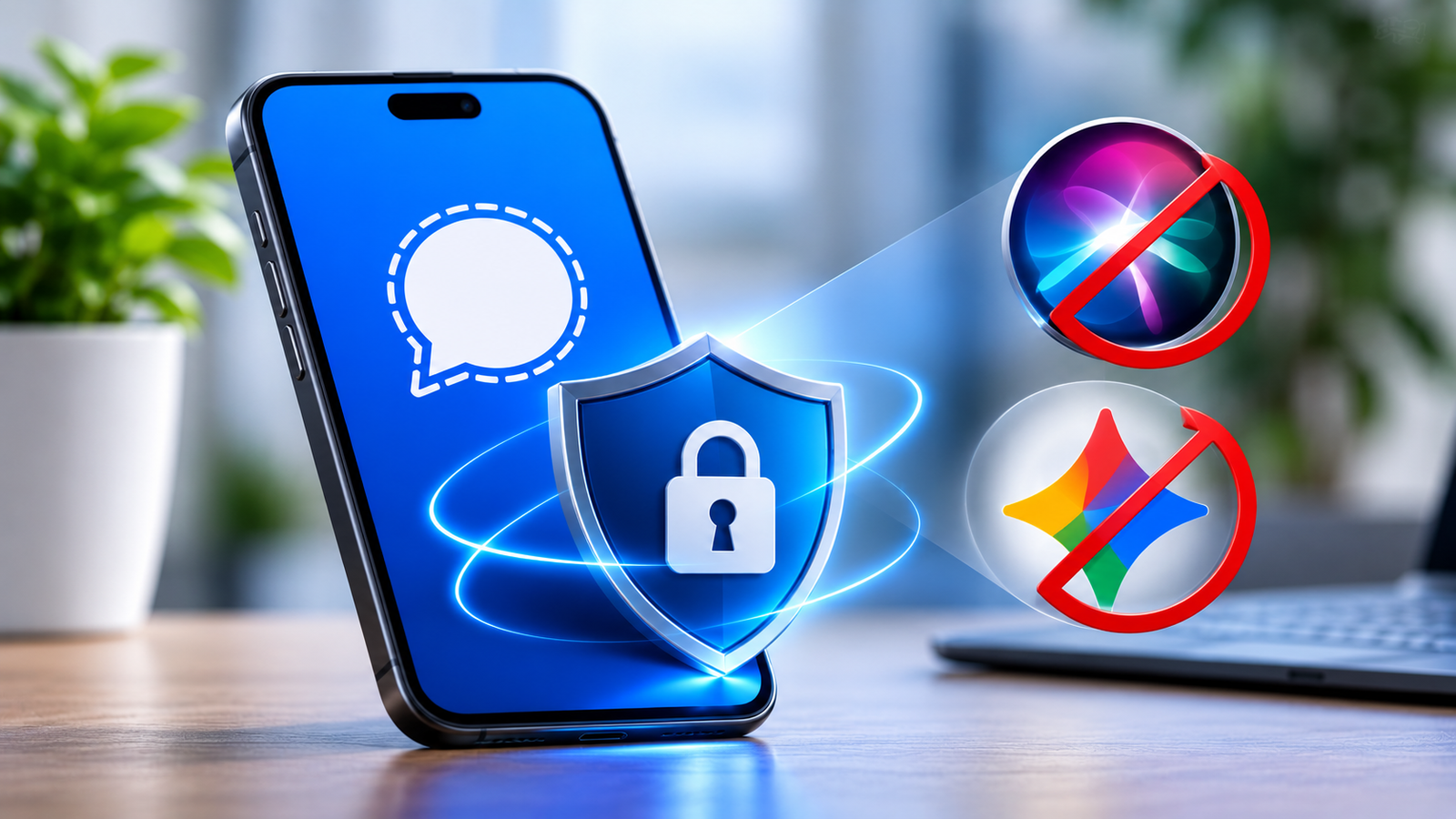
Encrypted messaging platform Signal has introduced new privacy protections designed to prevent artificial intelligence assistants, including Apple’s Siri and Google’s Gemini, from accessing private conversations displayed on mobile devices.
The update addresses growing concerns about operating system-level AI features that can inspect on-screen content while performing tasks for users. Although Signal uses end-to-end encryption to protect messages, the company warns that encryption cannot prevent an AI assistant from accessing conversations after they have been decrypted and displayed on a device.
Signal President Meredith Whittaker announced the changes on November 20, 2026, explaining that the company is taking steps to restrict AI systems from capturing sensitive conversation data.
How AI Assistants Could Access Signal Conversations
Modern mobile operating systems increasingly integrate AI assistants capable of understanding and interacting with content displayed on a device.
Features such as Google’s Gemini Intelligence and Apple’s Siri Onscreen Awareness can use screen content to provide contextual responses and complete user requests.
This creates a privacy concern for messaging applications. Once a message is decrypted and displayed, an operating system-level AI assistant may be able to capture its contents through screen-reading or screenshot mechanisms.
As a result, sensitive information could become accessible to AI systems and their associated processing infrastructure, potentially exposing messages belonging to every participant in a conversation.
Signal says this creates a gap between application-level encryption and the broader privacy protections available at the operating system level.
Signal Introduces Screenshot and Screen-Access Restrictions
Signal has implemented different protections across iOS and Android to limit AI-assisted screen capture.
On iOS 27:
Signal introduced a setting called Block Siri AI, which is enabled by default on supported devices. The protection prevents Siri AI from capturing Signal conversations and also blocks screenshots within the application.
Users can find this option under Settings → Privacy → Block Siri AI. It can be temporarily disabled when screenshots are necessary.
On Android:
Signal uses its existing Screen Security functionality to prevent AI assistants from accessing conversations through screen capture. The application automatically enables this protection when it detects an AI assistant attempting to read the Signal screen.
Users can also enable it manually under Settings → Privacy → App security → Screen security.
The protections are available in Signal 8.37 or later on iPhone running iOS 27 or later, and Signal 8.35.1 or later on Android.
End-to-End Encryption Does Not Prevent On-Screen Data Exposure
Signal’s announcement highlights an important distinction between encrypted communication and on-device data protection.
End-to-end encryption protects messages while they are transmitted between participants. However, once messages are decrypted and displayed on a device, other applications and operating system services may potentially gain access through permitted system-level capabilities.
This means that even applications with strong encryption can face privacy risks from screen-reading features, AI assistants, accessibility permissions and other mechanisms that access locally displayed information.
Signal also acknowledged that screenshot restrictions do not address every possible access route. AI agents could potentially retrieve information through other mechanisms, including files already stored on a device.
The company describes its new protections as an incomplete measure rather than a comprehensive solution to operating system-level AI access.
Signal Calls on Apple, Google and Microsoft for Better Privacy Controls
Signal says application developers currently lack sufficiently clear technical controls and documentation to prevent operating system-level AI systems from accessing sensitive application data.
The company is calling on Apple, Google and Microsoft to introduce standardized mechanisms that allow developers to restrict AI access without compromising application functionality.
Its requests include:
- Application-level opt-out controls: Developers should have a clear way to prevent AI systems from accessing sensitive application content.
- Better technical documentation: Operating system providers should explain how AI assistants access screens, files, notifications and application APIs.
- Granular privacy controls: Developers should be able to restrict specific forms of AI data access rather than relying on broad workarounds.
Signal also highlighted limitations on macOS, where it cannot reliably block screenshot-based access by Siri AI. For macOS 27 users, the company recommends adding Signal to the Excluded Apps list under System Settings → Siri.
What This Means for Mobile Privacy and Enterprise Security
Signal’s move highlights an emerging security challenge as AI assistants become more deeply integrated into mobile operating systems.
Organizations increasingly rely on encrypted messaging applications to exchange confidential business information, internal discussions, credentials and operational details. However, application-level encryption alone may not be sufficient if operating system services can access the information after it appears on screen.
Security teams should consider the following measures:
- Educate employees about the risks of sharing confidential information with on-device AI assistants.
- Review AI assistant permissions and screen-reading capabilities on managed devices.
- Establish mobile device policies governing AI access to confidential applications.
- Keep messaging applications and operating systems updated.
- Review accessibility permissions and third-party AI integrations.
About the Author